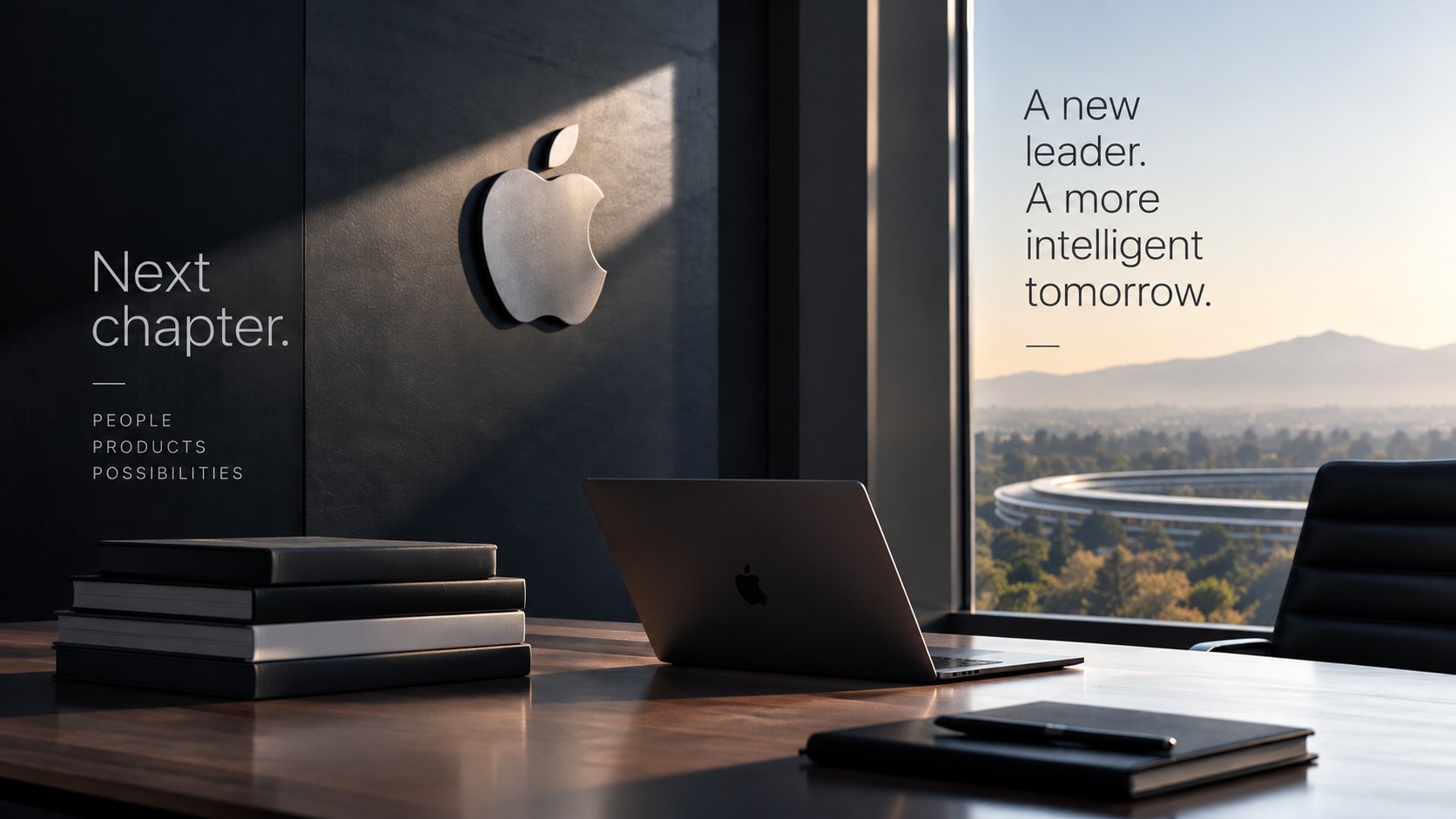
On September 1, 2026, John Ternus became Apple’s Chief Executive Officer, succeeding Tim Cook after 15 years at the helm. Cook moved into the newly created role of Executive Chairman, where he will continue to assist Apple on areas including engagement with policymakers around the world. The transition was unanimously approved by Apple’s board as part of a long-term succession process.
The Decision
What makes this succession worth studying isn’t that Cook stepped aside – every long-tenured CEO does that eventually. It is who the board picked to replace him.
Ternus has spent his entire Apple career in product and hardware engineering. He joined the company in 2001, became vice president of Hardware Engineering in 2013, and joined the executive team as senior vice president in 2021. He has orchestrated the engineering execution behind Mac’s transition from Intel processors to Apple Silicon and led the hardware development for the Apple Vision Pro and AirPods. Before Apple, he worked as a mechanical engineer at Virtual Research Systems and holds a mechanical engineering degree from the University of Pennsylvania.
That makes the appointment a strategic signal.
Why Ternus, Why Now?
Tim Cook’s Apple was built around a different vision.
Cook led a company whose products needed to be manufactured, distributed, and monetized at unprecedented scale. His tenure expanded Apple’s global operations while turning Services into a business generating more than $30 billion a quarter. Apple now operates at a financial scale few companies can match: its fiscal third quarter of 2026 produced $109.4 billion in revenue, up 16% year over year.
Ternus inherits a different challenge.
AI is changing what consumers expect from their devices and how technology companies compete. Apple’s response has increasingly centered on integrating intelligence into the products and operating systems it already controls rather than competing solely on the scale of cloud-based models.
At WWDC26, Apple introduced its third generation of Foundation Models, a family spanning on-device and Private Cloud Compute models. The models were custom-built in collaboration with Google, while Apple continues to emphasize privacy, power efficiency, and deep integration into device operating systems.
That makes Ternus an intriguing choice. In addition to being an AI researcher, his advantage comes from his understanding of the engineering constraints involved in turning advanced technology into products people actually use.
What Apple Gives Up
Apple is giving up something real.
Ternus has spent his career close to products and engineering. Cook spent his career building expertise in operations, supply chains, capital allocation and relationships with governments and other external stakeholders.
Apple appears to have designed around that gap rather than asking one person to replicate everything Cook brought to the role.
Cook is staying.
As Executive Chairman, he will continue to contribute to selected areas of the business, including policymaker engagement. That creates an unusual leadership configuration: the new CEO can concentrate on leading Apple’s next product and technology chapter while the company’s former CEO remains close enough to provide continuity where his experience is most valuable.
The decision therefore may be bigger than choosing Ternus.
It may represent a different view of what a CEO needs to be.
A Different Kind of CEO
Apple does not need Ternus to become another Tim Cook.
It needs to find out whether a leader with deep product and engineering experience can help the company turn its existing advantages – custom silicon, tightly integrated hardware and software, a vast installed base and a privacy-focused AI architecture – into a durable position in the AI era.
Apple’s latest Foundation Models are already designed to operate across both devices and Private Cloud Compute, while its developer frameworks increasingly allow AI capabilities to be integrated directly into applications and experiences.
That gives Ternus an interesting starting position. Apple does not have to build an entirely new distribution system for AI. It already owns the devices, operating systems, silicon, and ecosystem through which intelligence can reach hundreds of millions of people.
But that advantage only matters if Apple can execute.
What Apple Is Betting On
The September 9 Apple event will offer Ternus his first major public test as CEO. It will show how the company translates the strategy into its next generation of products and experiences.
If Ternus succeeds, Apple’s decisions could become a model for succession during technological disruption: when the company’s dominant problem changes, the ideal CEO may need to change with it.
Apple’s board has already made its choice.
The next few years will reveal whether it correctly identified the problem Apple needs to solve next.