



Materials science is currently witnessing a quiet revolution, one that isn’t happening on billboards but in the high-tech laboratories scattered across the United States. While silicon had its moment in the 20th century, the 21st century is looking increasingly like the era of two-dimensional nanomaterials. Among these, a specific family of layered ceramics and their conductive derivatives are stealing the spotlight. As industries from aerospace to consumer electronics scramble for lighter, faster, and more durable components, the hunt for high-quality MXene and MAX-phase in America has intensified. These materials are no longer just academic curiosities; they are becoming the backbone of next-generation technology.
The United States has a long history of leading material innovation, and the push to commercialize these specific nanostructures is the latest chapter in that story. The excitement stems from a simple fact: these materials break the rules. They offer a combination of properties that traditional materials cannot match. Imagine a material that conducts electricity like a metal but withstands heat like a high-grade ceramic. That is the promise of MAX-phases. Now, imagine taking that material and peeling it into sheets just a few atoms thick to create a conductive ink that can turn a piece of paper into a battery. That is the reality of MXenes.
This article explores why these materials are so critical right now, how American industries are adopting them, and the complex science that makes them tick.
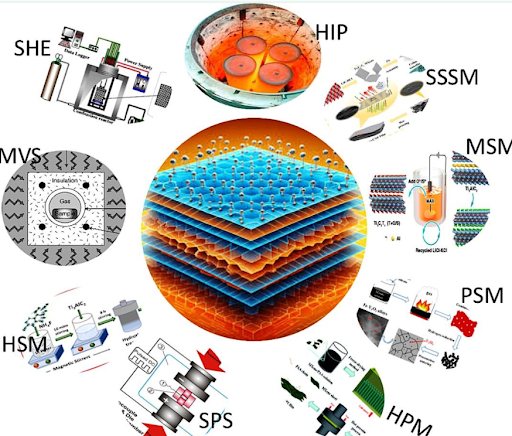
The Science Behind the Hype
To understand why everyone is talking about these materials, we have to look at their atomic structure. It all starts with the MAX-phase.
What is a MAX-phase?
MAX-phases are a large family of ternary carbides and nitrides. They get their name from their chemical formula: $M_{n+1}AX_n$.
- M: A transition metal (like titanium, vanadium, or chromium).
- A: An element from groups 13 or 14 of the periodic table (like aluminum or silicon).
- X: Carbon or nitrogen.
These three elements stack in layers. The “M” and “X” layers form strong bonds, creating rigid ceramic-like blocks. Sandwiched between them are the “A” layers, which are more weakly bonded. This unique layering gives MAX-phases their “dual personality.”
They behave like metals because they are:
- Electrically conductive.
- Thermally conductive.
- Machinable (you can cut them with a regular saw, unlike most ceramics).
- Resistant to thermal shock.
They behave like ceramics because they are:
- High stiffness.
- Lightweight.
- Resistant to oxidation and corrosion.
This combination is rare. Usually, if you want something hard and heat-resistant, you accept that it will be brittle and an electrical insulator. MAX-phases proved that you could have it all.
The Birth of MXenes
In 2011, researchers at Drexel University in Philadelphia made a breakthrough. They discovered that if you put a MAX-phase in a specific acid solution, you could selectively etch away the “A” layer (the aluminum or silicon).
Think of a MAX-phase like a book. The “M” and “X” layers are the pages, and the “A” layers are the glue holding the pages together. When you dissolve the glue, the pages separate. These separated pages are called MXenes.
The resulting material is a two-dimensional sheet, similar to graphene but with much more chemical versatility. MXenes are hydrophilic, meaning they mix easily with water. This is a massive advantage over graphene, which hates water and is notoriously difficult to process into inks or sprays without toxic chemicals. You can take MXene powder, mix it with water, and paint it onto a surface to make it conductive. That ease of processing is a game-changer for American manufacturing.
Applications Driving the US Market
The demand for these materials in the US isn’t driven by a single industry. It is a broad, multi-sector push. Companies realize that standard materials copper, lithium-ion, silicon are reaching their physical limits. To get better performance, they need new building blocks.
1. Energy Storage: Beyond Lithium-Ion
This is perhaps the most urgent application. Our hunger for energy storage is insatiable. We want electric vehicles (EVs) that drive 500 miles on a charge and refill in ten minutes. We want phones that last for days.
Current battery technology relies heavily on graphite anodes. Graphite is good, but it is slow. It takes time for ions to tuck themselves between the layers of graphite (a process called intercalation).
MXenes are different. Their surface chemistry and open structure allow ions to zip in and out at incredible speeds. This makes them ideal for:
- Supercapacitors: These devices store energy physically rather than chemically. They charge instantly but usually don’t hold much power. MXenes boost their storage capacity significantly, bridging the gap between batteries and capacitors.
- Battery Electrodes: Replacing or enhancing graphite with MXene can drastically reduce charging times.
- Solid-State Batteries: MXenes can help stabilize the electrolytes in solid-state batteries, which are safer and more energy-dense than the liquid-filled batteries we use today.
2. Electromagnetic Interference (EMI) Shielding
Every electronic device emits electromagnetic waves. If you don’t block these waves, your phone would interfere with your pacemaker, or your microwave would crash your Wi-Fi.
Traditionally, we shield electronics by wrapping them in metal foil or cans. This works, but it is heavy and bulky. As devices get smaller (think smartwatches and hearables) and lighter (think drones and aerospace), heavy metal shielding becomes a problem.
MXenes are exceptional EMI shields. Because they are highly conductive and layered, they reflect and absorb electromagnetic waves very efficiently. A coating of MXene thinner than a human hair can provide the same shielding as a thick sheet of copper. For the US defense and aerospace sectors, where every gram of weight savings counts, this is revolutionary.
3. Wearable Technology and Sensors
The “Internet of Things” (IoT) demands sensors everywhere on our bodies, in our homes, and on our machines. We need sensors that are flexible, sensitive, and cheap to make.
MXenes are naturally flexible. You can print them onto plastic, fabric, or paper. They are also incredibly sensitive to changes in their environment. If you stretch a piece of MXene-coated fabric, the electrical resistance changes. This allows for the creation of:
- Strain sensors: To monitor structural health in bridges or aircraft wings.
- Gas sensors: To detect toxic leaks in industrial plants.
- Biosensors: To monitor glucose levels or detect viral proteins in sweat or blood.
4. Water Purification and Desalination
Clean water is a growing concern globally and in parts of the US. The layered structure of MXenes can act like a molecular sieve. By controlling the space between the layers, scientists can allow water molecules to pass through while blocking salts, heavy metals, and bacteria.
Using sunlight to evaporate water (solar desalination) is another area where MXenes shine. They are excellent at absorbing light and converting it to heat, making the evaporation process much more efficient than standard black materials.
The Manufacturing Landscape in America
Knowing a material works in a lab is one thing; making tons of it is another. For a long time, MAX-phases and MXenes were stuck in the “valley of death” , the gap between academic discovery and commercial mass production.
In the early days (2011–2015), if a company wanted to test MXenes, they had to partner with a university or hire a chemist to make a few grams. The process was finicky. It involved dangerous acids (like hydrofluoric acid) and took days.
Today, the landscape in America has shifted. We are seeing the emergence of specialized nanomaterial manufacturers who have cracked the code on scaling up.
Challenges in Scaling Up
Producing these materials at an industrial scale involves overcoming three main hurdles:
- Safety and Environmental Control
The etching process often uses harsh chemicals. Scaling this up means building facilities that can handle these chemicals safely, with robust waste management systems. US regulations are strict, so manufacturers invest heavily in closed-loop systems that recycle acids and minimize waste. - Batch Consistency
In nanomaterials, consistency is everything. If one batch of MXene flakes has an average size of 1 micron and the next batch is 5 microns, the conductivity will change completely. Customers need to know that the material they buy today will behave exactly like the material they bought last month. Achieving this requires precise control over temperature, reaction time, and mixing speeds. - Cost Reduction
Titanium and other transition metals aren’t cheap. The synthesis process adds more cost. For these materials to replace copper or activated carbon, the price needs to come down. This is happening as production volumes increase, but it remains a key focus for the industry.
Innovations in Synthesis
To tackle these challenges, American researchers and companies are developing new ways to make MXenes.
- Fluorine-Free Etching: The traditional method uses hydrofluoric acid, which is dangerous. New methods use safer Lewis acids or molten salts to etch the MAX-phase. This makes the process safer and more environmentally friendly.
- Bottom-Up Synthesis: Instead of etching a MAX-phase (top-down), some groups are trying to build MXenes atom by atom (bottom-up). This is harder to do but offers more control over the final structure.
- In-Situ Polymerization: Some manufacturers are creating MXene-polymer composites directly, skipping the step of isolating the pure powder. This streamlines the production of conductive plastics.
The Strategic Importance of Domestic Supply
Why is it so important for America to have its own source of these materials? It comes down to supply chain resilience.
During recent global disruptions, we saw how fragile international supply chains can be. Semiconductors, batteries, and medical supplies were all delayed because the US relied heavily on overseas production.
MAX-phases and MXenes are considered “critical materials” for future technologies. If the US relies solely on imported nanomaterials, it risks being cut off from essential components for defense, energy, and communications infrastructure. Building a domestic ecosystem from raw ore mining to MAX-phase synthesis to MXene etching and final product integration is a strategic priority. This aligns with broader federal initiatives to strengthen American manufacturing and regain leadership in advanced batteries and semiconductors.
How to Work with MAX-phases and MXenes
For engineers and product designers looking to integrate these materials, there is a learning curve. They don’t behave exactly like standard metals or plastics.
Handling and Storage
MXenes, in particular, can be sensitive to oxidation. If you leave a jar of MXene paste open in a humid room, the edges of the flakes can start to degrade, turning into titanium dioxide (a white paint pigment) which is not conductive.
- Storage: They are best stored in solution, kept cool, and sealed under an inert gas like argon if possible.
- Shelf Life: While stability has improved with new synthesis methods, they are not shelf-stable forever like a block of aluminum.
Processing Methods
The beauty of MXenes is their versatility in processing.
- Inkjet Printing: You can load MXene ink into a standard printer and print circuits on paper.
- Spray Coating: Large areas can be coated using industrial spray guns.
- Filtration: You can pour a solution through a vacuum filter to create a freestanding “paper” made entirely of MXene. This paper is flexible, conductive, and tough.
- Extrusion: Mixed with polymers, they can be 3D printed into complex shapes.
![Image: An engineer holding a flexible, transparent plastic sheet with a printed electronic circuit made from MXene conductive ink.]
Future Outlook: What Comes Next?
We are currently in the “early adopter” phase. The science is solid, the initial products are hitting the market, and the supply chain is stabilizing.
Over the next five to ten years, we can expect to see:
- Standardization: Just as we have grades of steel (304, 316, etc.), we will likely see standardized grades of MXenes tailored for specific uses—Grade A for batteries, Grade B for shielding, etc.
- Price Parity: As production ramps up, costs will drop, making these materials viable for lower-margin consumer goods, not just high-end electronics.
- Hybrid Materials: The most exciting developments might come from mixing MXenes with other 2D materials like graphene or boron nitride to create hybrids that leverage the best properties of both.
Conclusion
The story of MAX-phases and MXenes is a classic example of American innovation: taking complex fundamental science and wrestling it into practical, usable forms. We moved from discovering a new arrangement of atoms in a university lab to manufacturing tons of the material for real-world applications.
For industries in the United States, the availability of these advanced materials opens doors that were previously locked. We can now design batteries that don’t die after a year, clothes that monitor our health, and aircraft that are lighter and invisible to radar.
The transition from silicon to 2D materials won’t happen overnight, but the momentum is undeniable. Securing a reliable, high-quality supply of these materials is the first step for any company wishing to stay competitive in the coming decade. As we continue to refine the production and application of these nanostructures, we aren’t just making better materials; we are building the foundation for the future of American technology.